

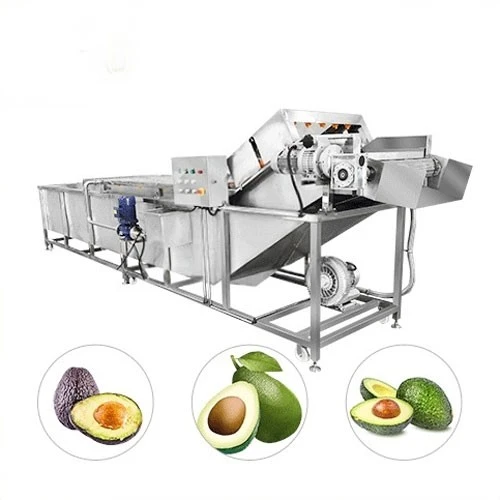
Industrial Fruit Washing Machine | Heavy-Duty Fresh Produce Cleaning Systems
Engineered for commercial fruit processors, fresh-cut salad facilities, beverage bottling plants, and agricultural export hubs. Built for continuous multi-shift operation, strict microbial hygiene compliance, and zero-bruise fruit handling.
Multi-Stage Cleaning Mechanics
Industrial fruit processing requires removing field heat, surface dust, pesticide residues, and insect fragments without compromising cellular integrity. Depending on your fruit variety, our systems integrate up to four distinct cleaning zones:
Vortex Bubble Agitation: Compressed air is injected via high-density micro-perforated aeration pipes, generating rolling water turbulence that gently dislodges soil from irregular contours (ideal for delicate items like strawberries, grapes, and blueberries).
Controlled Spray Rinsing: Overhead and lateral high-pressure spray headers use fresh or filtered water to flush loosened contaminants as produce transitions between zones.
Submerged Immersion & Convection: Fruits float or are gently propelled through a deep-water basin, ensuring uniform soaking times and preventing bottom impact.
Optional Roller Brush Module: For firm-skinned produce (apples, citrus, peaches), soft food-grade nylon roller brushes mechanically scrub away stubborn field wax or embedded dirt layers.
Gentle Product Handling & Bruise Prevention
Excessive mechanical impact causes internal bruising, rapid post-wash decay, and high downstream rejection rates. To safeguard delicate fruit skins for fresh packaging or extended cold-chain storage, our equipment features:
Inverter-Controlled Variable Speed: AC frequency drives regulate belt and drum rotation speed to match exact dwell times with fruit fragility.
Optimized Drop Transitions: Transfer heights between discharge zones and downstream conveyors are strictly controlled under 50 mm and lined with food-grade polyurethane buffer plates.
Hydro-Cushioning Basin: Infeed zones utilize a deep-water landing cushion to prevent hard collisions against stainless steel tank walls.
Premium SUS304 Sanitary Construction
Food processing lines face constant moisture, organic fruit acids (citric and malic), and aggressive daily chemical sanitization.
Heavy-Duty Material Composition: Structural frames, water tanks, enclosure panels, and mesh conveyor belts are fabricated from AISI 304 stainless steel (with structural plate thicknesses ranging from 2.0 mm to 3.0 mm), eliminating structural oxidation and pitting.
Hygienic Weld Finishes: All internal product-contact welding seams are argon-arc welded, ground flush, and chemically passivated to eradicate micro-crevices where bacteria could colonize.
Continuous-Flow Production Integration
Engineered to replace labor-intensive batch dipping tanks, our systems integrate seamlessly into high-capacity automated lines:
[Infeed Hopper] ---> [Bubble Agitation Tank] ---> [Fresh Water Spray Zone] ---> [Dewatering/Air-Drying Section] ---> [Discharge Conveyor]
Throughput Scalability: Standard industrial models support capacities from 1,000 kg/h to 5,000 kg/h, matching standard industrial sorting, grading, and packaging speeds.
Labor Optimization: Replaces large manual line sorting teams, drastically cutting personnel requirements during peak harvest seasons while maintaining a steady, uninterrupted output.
Water Recycling and Filtration System
High water volume consumption drives up operating costs. Our washing systems incorporate closed-loop water conservation engineering:
Multi-Tier Debris Separation: Wash water passes through primary filtration screens (capturing leaves, stems, and heavy soil) before entering a multi-stage sedimentation chamber.
Closed-Loop Recirculation: High-efficiency centrifugal pumps cycle filtered water back to the bubble injection manifolds, reducing fresh water consumption by 40% to 60% compared to single-pass configurations.
Sanitation and Maintenance Accessibility
To satisfy HACCP, FDA, and international sanitation protocols, equipment must be engineered for fast, tool-free or low-tool cleaning:
Quick-Release Spray Manifolds: Spray pipes feature sanitary quick-clamp connections, allowing operators to flush internal pipe networks within minutes.
Sloped Drainage Bottoms: V-shaped and sloped tank floors terminate in large-diameter discharge valves, ensuring complete water evacuation and preventing stagnant pooling during end-of-shift washdowns.
Isolated Mechanical Drives: Drive motors, gearboxes, and electrical control panels are housed in IP55-rated waterproof enclosures, safely separated from the wet processing zone.
Technical Specifications & Customization Parameters
|
Parameter |
Standard Industrial Configuration |
Customization Options |
|
Primary Material |
SUS304 Stainless Steel |
SUS316 Stainless Steel (for high-salinity or high-acid processing) |
|
Drive & Control |
Gear motor with frequency inverter |
Explosion-proof motors, servo-driven precision belts |
|
Electrical Panel |
Water-resistant push-button station |
PLC with Touch-Screen HMI (Siemens / Schneider components) |
|
Voltage Options |
380V / 50Hz / 3-Phase |
Tailored to regional grids (220V, 415V, 480V, 60Hz) |
|
Solid Waste Removal |
Manual clean-out trays |
Automatic rotary drum filter or scraper-type solid waste conveyor |
Target Industry Applications
Fresh Fruit Packing Houses
Pre-cleaning apples, pears, and citrus prior to optical sorting, waxing, and boxing.
Juice & Concentrate Plants
High-volume washing of grapes, berries, and stone fruits prior to crushing and enzymatic extraction.
Frozen Fruit Processing (IQF)
Thorough surface decontamination of delicate berries and sliced fruits before individual quick freezing tunnels.
Frequently Asked Questions
Q: How does the machine prevent soft fruits (like strawberries or raspberries) from crushing?
A: Soft fruits are processed using a specialized low-pressure bubble wash configuration combined with a submerged water-cushion transport belt. Instead of mechanical agitation or high-impact spraying, controlled buoyancy carries fruit smoothly across the water surface, minimizing physical damage.
Q: What utility connections are required on-site?
A: The installation site requires a continuous fresh water supply line (typically 1-inch to 2-inch connection), a dedicated floor drainage trench capable of handling maximum wastewater output, and a 3-phase industrial electrical power source matching the specified motor load.
Q: Can this machine be integrated with existing sorting or grading lines?
A: Yes. Discharge conveyor heights, belt widths, and electrical interlocks are custom-engineered to interface directly with existing downstream equipment, such as roller inspection tables, optical graders, or air-knife drying systems.
Q: What specifications must be provided to receive an accurate quotation?
A: To configure the optimal washing solution for your plant, please prepare the following details when inquiring:
Primary fruit varieties to be processed.
Required hourly processing capacity (kg/h).
Available factory floor space dimensions.
Downstream processing requirements (e.g., packaging, juicing, freezing, or cutting).
Hot Tags: fruit washing machine, China fruit washing machine manufacturers, suppliers, factory


