

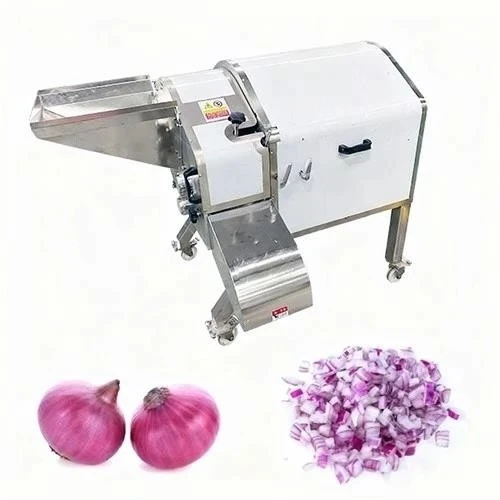

Industrial Onion Dicer for Continuous Cube Production
The Onion Dicer Machine is a conveyor-fed industrial cutter for processors that need repeatable cubes from prepared onions and comparable vegetables. Product travels continuously toward a compound blade assembly, where the installed cutting set determines the nominal cube dimensions. Standard references include 5 × 5 × 5 mm, 10 × 10 × 10 mm, and 15 × 15 × 15 mm. A broader cutting range of approximately 3–20 mm may be available with the corresponding blade configuration, but every required size should be confirmed before ordering.
Onions are demanding because layers can separate, soft bulbs can deform, and poorly trimmed ends can disturb feeding. At AGICO, we therefore discuss raw-material condition together with the desired finished piece. Bulb diameter, variety, firmness, temperature, peeling quality, root and top removal, feed depth, cube tolerance, and downstream use all affect the practical result. A sample trial or clear photographs of both the incoming onion and acceptable dice help turn a general capacity request into a workable machine specification.
Key Features That Influence Daily Operation
-
Continuous Conveyor Feeding
The conveyor provides a steady route into the cutter. Feeders should spread prepared onion pieces rather than creating a deep, uneven pile, because presentation influences loading and cube consistency.
-
Compound Blade Assembly
Successive cutting actions form diced pieces instead of relying on one simple slice. Blade sharpness, alignment, the installed set, and onion firmness determine whether layers are cut cleanly or pulled apart.
-
Selectable Cube Sizes
Different blade sets support different nominal sizes. Buyers should specify the target, tolerance, fines limit, and end use; a soup ingredient and a retail fresh-cut pack do not share the same acceptance criteria.
-
Mobile Floor-Standing Body
The stainless industrial body and mobile configuration support production-floor placement and cleaning access. Wheel locks, service clearances, floor condition, and safe utility routing still require site review.
Reference Technical Data
The following values reproduce the user-supplied reference configuration. Final specifications, blade set, construction details, and achievable product quality should be confirmed in the quotation and technical agreement.
| Parameter | Specification |
|---|---|
| Machine Type | Conveyor-type industrial vegetable dicer |
| Processing Capacity | 500–800 kg/h |
| Motor Power | 1.5 kW |
| Electrical Supply | 380 V / 50 Hz |
| Machine Dimensions | 2,400 × 1,000 × 1,340 mm (L × W × H) |
| Machine Weight | Approximately 216 kg |
| Standard Cube Sizes | 5 × 5 × 5 mm; 10 × 10 × 10 mm; 15 × 15 × 15 mm |
| Available Cutting Range | Approximately 3–20 mm, configuration-dependent |
| Feeding Method | Continuous conveyor feeding |
| Cutting System | Compound blade assembly |
| Finished Product | Cubes or diced pieces |
| Installation | Floor-standing mobile configuration |
| Construction | Stainless-steel industrial body |
Capacity should be interpreted as a working range, not a guaranteed output for every onion and cube size. Smaller cuts create more cutting work and may expose more broken layers; oversized or poorly prepared bulbs can interrupt feeding; and a slow receiving station can force stops even when the cutter is ready. Our team will normally ask for average bulb weight, prepared dimensions, desired cube size, hourly flow, shift length, acceptable fines, and the next process before discussing a suitable operating target. Recording sample results by size also gives operators a practical reference for later blade changes and seasonal raw-material variation.
Electrical and spatial checks are equally important. Confirm the destination voltage, frequency, phase, local disconnect, cable route, and protection requirements. The 2,400 × 1,000 × 1,340 mm reference envelope does not include every working clearance. Reserve space for loading, blade-set removal, opening covers, waste removal, sanitation, movement of the machine, and access to the discharge. A mobile unit must stand on a level floor with its casters secured during operation.
Applications and Production-Line Interfaces
The machine can support onion preparation for frozen foods, sauces, soups, fillings, ready meals, catering ingredients, and other processes where defined diced pieces are required.
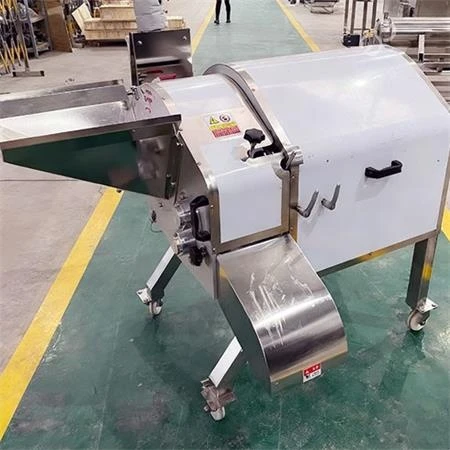
Plan a direct route from peeled-onion preparation to the conveyor while keeping operators clear of moving and cutting parts. Provide stable floor space, locked casters, and enough room for inspection and sanitation.
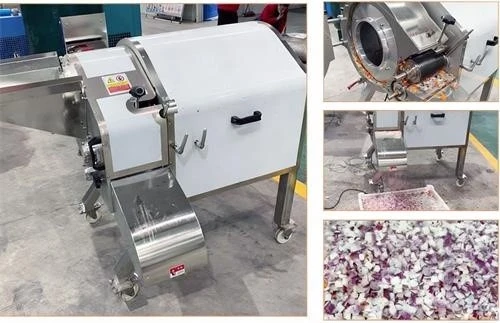
The receiver, conveyor, tote, or packing station must keep pace with actual discharge. Limit excessive drop and accumulation when cube shape matters, and remove fines or separated layers according to the product specification.
Operating Workflow and Changeover
01
Prepare the onions
Remove peel and unsuitable material, trim roots and tops to the agreed condition, and separate bulbs that exceed the confirmed feed size. Consistent preparation supports steadier cutting.
02
Feed continuously
Distribute prepared onions across the conveyor at a controlled depth. Avoid sudden surges that overload the cutting chamber or leave the downstream receiver unable to clear finished product.
03
Dice and discharge
The compound blade set produces the specified nominal cube. Operators monitor piece shape, fines, blade condition, feed behavior, and discharge flow rather than judging performance only from motor running time.
04
Clean or change size
Stop and isolate the machine under the plant procedure. Remove retained onion, clean accessible food-contact areas, inspect blades and guards, install the approved cutting set, and verify reassembly before restart. AGICO recommends confirming removal tools, cleaning chemicals, drainage, spare blades, and inspection frequency during project planning.
Onion Dicer Machine FAQ
-
Must onions be peeled before dicing?
The dicer should receive onions prepared to the agreed condition. Loose peel, untrimmed roots, unsuitable bulbs, and inconsistent feed pieces can affect presentation and increase waste, so preparation requirements should be confirmed during trials.
-
How is the cube size selected?
The installed compound blade set establishes the nominal size. Specify the target dimensions and tolerance instead of requesting only "small" or "large" dice. Confirm whether 5, 10, or 15 mm is suitable or whether another available set is needed.
-
Does 500–800 kg/h apply to every product?
No. It is reference data. Onion size and firmness, preparation quality, selected cube size, feeding consistency, blade condition, inspection stops, and downstream collection all influence sustained production.
-
What information should be sent to AGICO?
Provide onion variety and condition, prepared dimensions, target cube size and tolerance, acceptable fines, hourly and daily volume, electrical standard, upstream preparation, downstream destination, factory layout, and cleaning expectations.
Hot Tags: onion dicer machine, China onion dicer machine manufacturers, suppliers, factory


