

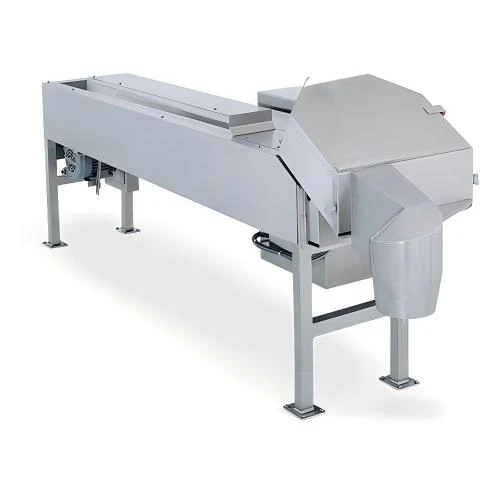
Industrial Carrot Slicing Machine
The AGICO Carrot Slicing Machine is designed for continuous bias slicing of carrots and other elongated foods. A conveyor presents the product to a rotating slicing wheel, helping a production team move from irregular manual cutting to a repeatable industrial process. The standard configuration produces a 30-degree bias cut, while the OC-45 configuration is intended for buyers who need a 45-degree presentation.
This machine can prepare flat or crinkle slices for fresh-cut packs, frozen vegetable lines, dehydration, cooking, snack preparation, and ingredient processing. It is not simply a high-speed knife. Product diameter, firmness, feed orientation, chosen thickness, and downstream handling all affect the final result. At AGICO, we recommend confirming these variables with representative material before the cutting specification is finalized.

Features That Matter in Production
Controlled Bias Cutting
The standard 30-degree geometry creates an elongated face that gives carrot slices a distinctive appearance and useful surface area. The optional 45-degree setup provides another presentation format when a steeper cut is preferred.
Flat or Crinkle Output
Changing the cutting components allows the line to produce smooth bias slices or textured crinkle slices. The required style should be specified before manufacture so the cutting set matches the intended product.
Continuous Belt Feeding
The feed belt supports steady product delivery rather than stop-start batch loading. Stable presentation reduces variation caused by hand feeding and helps the operator maintain a predictable production rhythm.
Industrial Line Layout
A 2,973 mm machine length needs practical clearance for loading, discharge, cleaning, and service. The 891 mm width and 1,135 mm height should be checked against doorways and line elevations.
Technical Data of the Carrot Slicing Machine
| Parameter | Specification |
|---|---|
| Suitable Products | Carrots, celery, okra, plantains, bread and similar elongated products |
| Cutting Angle | 30° standard; 45° with Model OC-45 configuration |
| Cutting Styles | Bias flat slices and bias crinkle slices |
| Standard Thickness Range | 1/16–1-3/4 in (1.6–44.5 mm) |
| Optional Thickness Range | 0.030–0.120 in (0.8–3.0 mm), optional configuration |
| Typical Carrot Cut | 1/8 in (3.2 mm) bias flat slice |
| Maximum Product Diameter / Width | 2.5 in (63.5 mm) |
| Slicing Wheel Diameter | 16.625 in (422.3 mm) |
| Main / Feed Belt Motor | 3 HP (2.2 kW) / 3/4 HP (0.56 kW) |
| Dimensions (L × W × H) | 2,973 × 891 × 1,135 mm (117.04 × 35.08 × 44.70 in) |
| Net Weight | 349 kg (770 lb) |
| Operating Mode | Continuous automatic production with conveyor-belt feeding |
Thickness ranges refer to different cutting configurations. Confirm the required range and cutting style when requesting a quotation.
How the Slicing Process Works
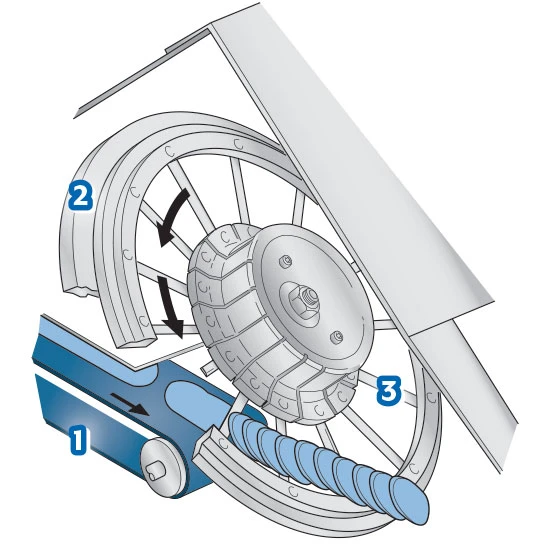
Prepared carrots are placed on the conveyor with their long axis aligned for stable travel. The belt carries each piece toward the cutting zone, where the slicing wheel produces the selected bias geometry. Slices then leave through the discharge area for collection or transfer to a downstream conveyor. A consistent feed pattern matters because severely curved pieces, mixed diameters, or loose loading can change the way material meets the knife.
In one common scenario, a fresh-cut producer uses a 3.2 mm flat bias slice for retail vegetable mixes. In another, a frozen-food plant selects a thicker slice that tolerates blanching and handling. A snack or dehydration line may choose a thinner configuration but must evaluate moisture, breakage, and drying behavior. These are different processing problems, even when the same raw vegetable is involved.
Machine Footprint and Line Planning
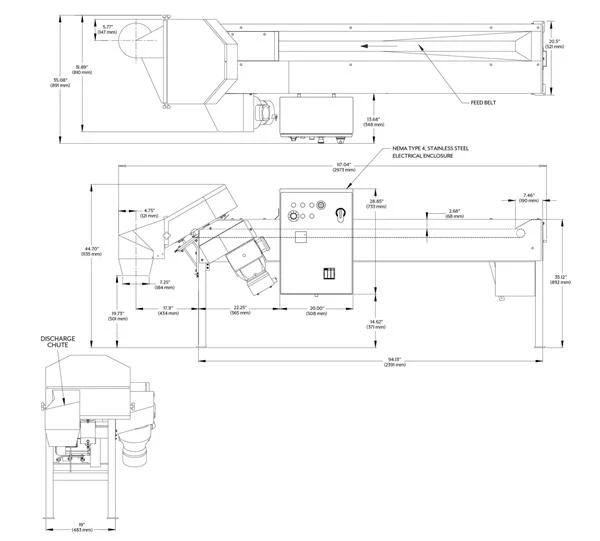
The long feed section is part of the working system, not unused floor space. It gives elongated products time to settle before cutting. Allow additional room around the stated envelope for operators, guards, belt cleaning, knife access, and safe removal of product containers. AGICO engineers can review the proposed upstream and downstream arrangement when the buyer provides a simple line drawing with transfer heights and available aisle width.
Selecting the Right Configuration
Begin with the finished slice rather than the maximum catalog range. Specify the preferred angle, flat or crinkle surface, target thickness, acceptable tolerance, and the next process. Then define the raw material: minimum and maximum diameter, typical length, temperature, firmness, and whether it arrives washed, peeled, or trimmed. The stated 63.5 mm maximum dimension should be treated as a feed limit, not proof that every product at that size will cut identically.
The standard 1.6–44.5 mm range covers many general bias-slicing duties, while the optional 0.8–3.0 mm configuration addresses a narrower thin-slice requirement. These ranges should not be combined into one promise. Our practical recommendation is to select the cutting system around one proven production target, then evaluate secondary sizes with samples. This reduces compromises in cut quality and simplifies operator setup.
Planning for Daily Operation
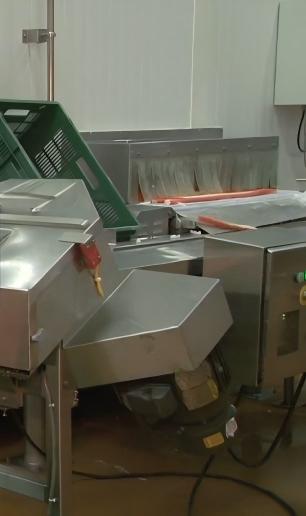
A real installation must also address loading height, discharge collection, washdown boundaries, electrical supply, and access to the drive and cutting wheel. The production photo illustrates why service clearance matters: adjacent equipment can restrict doors and maintenance zones if line spacing is decided only from overall dimensions.
Before shipment, AGICO recommends confirming the cut with representative carrots and recording the accepted sample. That reference gives operators, purchasing staff, and quality teams a shared definition of the expected slice.
Cleaning and Maintenance
Establish a cleaning routine based on the actual product and shift schedule. Stop and isolate the machine before entering the cutting zone. Remove retained carrot pieces, clean food-contact surfaces with suitable methods, and inspect the belt, guides, knives, and discharge path before restart. Abrasive tools or uncontrolled high-pressure spraying can damage finishes, bearings, or electrical components, so the final sanitation procedure should follow the supplied machine manual and the plant's hygiene program.
Cut quality is a useful maintenance signal. Increasing feathering, tearing, thickness variation, or product movement may indicate dull blades, incorrect alignment, belt wear, unsuitable feed condition, or a mismatch between the cutting set and the raw material. Record changes instead of compensating only by increasing feed speed.
Frequently Asked Questions
Can the machine make straight round slices?
This model is specified for bias cutting. Confirm the required geometry with AGICO if a perpendicular round slice is essential.
Are 30-degree and 45-degree cuts available on the same standard setup?
The standard angle is 30 degrees; the 45-degree cut is associated with the OC-45 configuration. State the angle when ordering.
Which thickness range should I use?
Select the standard or optional configuration according to the target product. Provide sample material and the required thickness rather than relying only on the broad published range.
Does the machine process products other than carrots?
It can be considered for celery, okra, plantains, bread, and similar elongated products, subject to diameter, firmness, feeding behavior, and sample-cut confirmation.
What information is needed for a quotation?
Send the product name, diameter range, target angle, slice style, thickness, hourly requirement, electrical standard, and available line space. Photos or physical samples make evaluation more reliable.
Hot Tags: carrot slicing machine, China carrot slicing machine manufacturers, suppliers, factory


