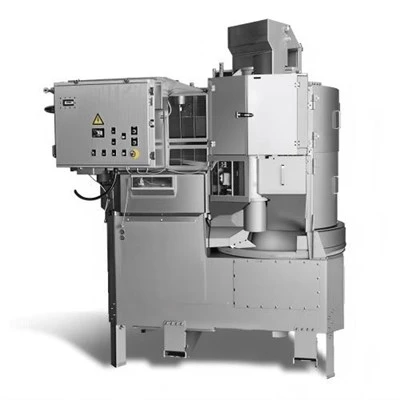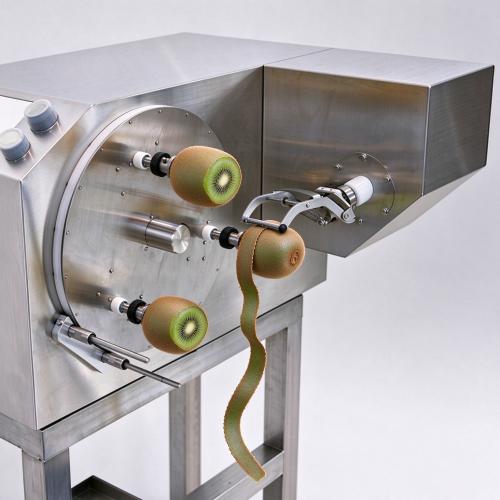

Industrial Kiwi Peeler Machine Overview
The AGICO kiwi peeler machine is designed for semi-automatic, continuous peeling of kiwi fruit with a diameter of 60–110 mm. Operators load fruit manually at each station, while the configured peeling mechanism carries out the cutting cycle. AGICO-2 provides two peeling stations and a listed processing range of 14–18 fruits per minute. AGICO-4 increases the station count to four and the listed range to 28–36 fruits per minute.
Peeling thickness can be adjusted from 1 to 3 mm. The appropriate setting depends on fruit diameter, shape, ripeness, surface condition, and the required finished appearance. Practical output also depends on sorting consistency, operator loading rhythm, and downstream collection or inspection. For this reason, model selection should consider the complete working sequence rather than station count alone. A representative fruit sample and a clear finished-product requirement help make the configuration discussion more specific. Both listed models use 1.5 kW installed power and require compressed air at 0.6 MPa.
Key Features for Controlled Kiwi Peeling
-
Two or Four Peeling Stations
AGICO-2 provides two stations, while AGICO-4 provides four. More stations raise the listed fruit-per-minute range, but the project also needs enough operators, sorted fruit, compressed air, and downstream handling capacity.
-
Adjustable Peeling Thickness
The supplied adjustment range is 1–3 mm. The setting should follow the actual fruit and desired result. A numeric setting is not a guarantee of identical peel removal when kiwi size, shape, or ripeness varies.
-
Defined Electrical and Air Demand
Both models list 1.5 kW installed power and require 0.6 MPa air pressure. Approximate compressed-air consumption is 20 L/min for AGICO-2 and 30 L/min for AGICO-4.
-
Stainless-Steel, Operator-Led Workflow
Food-grade stainless steel is specified for the supplied construction data. Manual loading keeps fruit presentation under operator control, while semi-automatic continuous operation supports a repeatable station-by-station working rhythm.
AGICO Technical Data
Compare the confirmed model data below. Blank AGICO-4 cells are intentionally retained because corresponding values were not supplied and should not be inferred from AGICO-2.
| Specification | AGICO-2 | AGICO-4 |
| Number of Peeling Stations | 2 | 4 |
| Processing Capacity | 14–18 fruits/min | 28–36 fruits/min |
| Approximate Hourly Output | 840–1,080 fruits/h | 1,680–2,160 fruits/h |
| Suitable Fruit Diameter | 60–110 mm | 60–110 mm |
| Adjustable Peeling Thickness | 1–3 mm | 1–3 mm |
| Installed Power | 1.5 kW | 1.5 kW |
| Required Air Pressure | 0.6 MPa | 0.6 MPa |
| Compressed-Air Consumption | Approximately 20 L/min | Approximately 30 L/min |
| Machine Dimensions | 750 × 1,500 × 2,000 mm | 1,140 × 1,500 × 2,000 mm |
| Approximate Weight | 800 kg | 1,000 kg |
| Construction Material | Food-grade stainless steel | |
| Standard Voltage | 380 V, 50 Hz, 3 Phase | |
| Alternative Voltage | Customizable | |
| Feeding Method | Manual loading | |
| Operation Mode | Semi-automatic continuous operation |
Kiwi Preparation and Line Integration
Consistent fruit preparation and balanced operator work support a manageable semi-automatic peeling process.
Sort Before Manual Loading
Prepare fruit within the specified 60–110 mm diameter range.
Remove unsuitable fruit and foreign material before the machine. Grouping kiwis by similar diameter, shape, and ripeness can make loading and adjustment more consistent. Operators should present fruit according to the supplied operating procedure and keep hands clear of the active peeling area. At AGICO, configuration discussion should include the normal fruit range and the number of operators available for each shift.
Coordinate Collection and Inspection
Plan how peeled fruit and removed peel leave the work area.
Downstream inspection, trimming, slicing, or packing capacity should correspond to the selected station count. Provide suitable containers or conveyors as applicable, and avoid a receiving bottleneck that interrupts manual loading. The work area also needs room for peel collection, safe operator movement, compressed-air connections, and access for cleaning.
Semi-Automatic Kiwi Peeling Workflow
01
Sort and Size
Check that fruit is suitable for processing and within the listed diameter range. Separate unusually shaped or unsuitable kiwis before loading.
02
Load Each Station
Operators manually present fruit to the available stations following the delivered safety and operating instructions.
03
Position and Peel
The configured mechanism performs the peeling cycle at the selected thickness. Observe the result and adjust within the confirmed range when fruit condition changes.
04
Discharge and Inspect
Collect peeled fruit, inspect the surface, and transfer it to trimming or the next process. Remove peel waste without obstructing the stations.
05
Clean and Check
After safe shutdown, remove peel residue from accessible food-contact and collection areas. Inspect applicable peeling components and air connections according to the supplied maintenance documentation.
Frequently Asked Questions
-
What kiwi size can the machine handle?
The supplied suitable diameter range is 60–110 mm for both models. Fruit shape and ripeness also influence practical positioning and the peeling result.
-
Are the hourly figures guaranteed?
No. They are supplied approximate ranges derived from the listed fruits-per-minute data. Actual output depends on fruit consistency, operator rhythm, settings, and downstream handling.
-
Is feeding automatic?
No. Manual loading is specified. The operating mode is semi-automatic continuous operation, so staffing and station coordination remain part of capacity planning.
-
How do I choose between AGICO-2 and AGICO-4?
Compare target throughput, operator availability, fruit preparation, compressed-air capacity, floor space, collection, and inspection capacity. The four-station model is wider and has higher approximate air consumption.
-
What should I provide before quotation?
Provide kiwi diameter, shape and ripeness range, target output, peeling requirement, available operators, voltage, frequency, phase, compressed-air supply, installation space, and downstream process. AGICO can then review the requested model against the actual site conditions.
Hot Tags: kiwi peeler machine, China kiwi peeler machine manufacturers, suppliers, factory, Automatic Fruit and Vegetable Cutting Machine, Automatic Vegetable Processing Line, French Fry Production Line, Fruit and Vegetable Dicing Machine, Optical Vegetable Sorting Machine, Potato Steam Peeling Machine