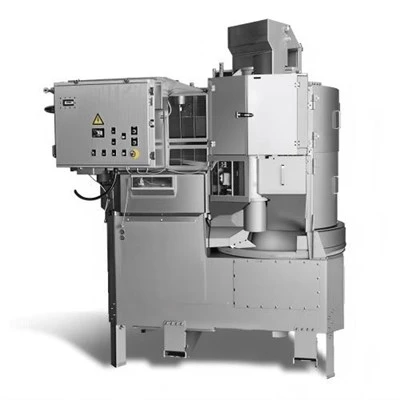
Commercial Melon Peeler Overview
Controlled Peeling for Large Round Produce
The Commercial Melon Peeler is a semi-automatic carousel machine designed for cantaloupes, honeydew melons, watermelons, pumpkins, and other round produce within the specified size range. An operator manually positions each product, while an optical sensor supports centering before the programmable cycle begins. A shape-following mechanical knife tracks the outer profile as the product rotates, and the finished piece is ejected automatically for collection or transfer to the next preparation stage.
-
6Carousel PositionsIndexed loading, peeling, and ejection sequence
-
400Pieces Per HourUpper rating under suitable product and operating conditions

The six-position carousel separates loading, peeling, and discharge activity around one indexed platform. Rated capacity is up to 400 pieces per hour, but actual output depends on fruit diameter, height, shape consistency, firmness, peel condition, recipe settings, operator rhythm, and downstream handling. The machine accepts products from 150 to 350 mm in diameter and up to 350 mm high. Those dimensions should be checked against representative samples, because a nominal diameter alone does not describe taper, stem shape, or surface irregularity.
At AGICO, we recommend reviewing the intended raw material and finished appearance before confirming the holder, knife path, and recipe. A cantaloupe requiring clean peel removal presents a different surface from a large watermelon or hard pumpkin. Sample evaluation helps define peeling depth, rotation speed, centering practice, and the amount of surface variation that the process can accommodate.
Key Features for Repeatable Melon Peeling
-
Six-Position Carousel
The indexed carousel provides separate positions for manual loading, processing, and automatic ejection. This arrangement supports a continuous operator rhythm without claiming fully automatic feeding. Stable output still requires suitable product grading and timely removal or transfer after discharge.
-
Optical Product Positioning
An optical positioning sensor helps establish a repeatable reference before peeling starts. The operator must still place the melon correctly and keep the sensing area clean. Sample trials should confirm how stem ends, color variation, and irregular profiles affect positioning.
-
Shape-Following Knife Path
The mechanical knife follows the rotating surface rather than applying one fixed cylindrical cut. Adjustable peeling depth helps balance rind removal against edible-product retention, but the correct value depends on fruit type, maturity, surface defects, and the required finish.
-
Programmable Touchscreen Recipes
The touchscreen stores operating recipes for repeat products and provides adjustment of peeling depth and rotation speed. Recipes should be verified after a variety or size change rather than treated as universal settings. Controlled trials reduce unnecessary adjustment during normal production.
AGICO Technical Data
Configuration should be based on representative produce, the required peeled finish, available utilities, operator access, and the intended receiving equipment. The table records the supplied machine data without adding unverified options or performance claims.
| Parameter | Specification |
| Processing Capacity | Up to 400 pieces/h |
| Operation Mode | Semi-automatic continuous operation |
| Carousel Positions | 6 |
| Product Diameter | 150–350 mm |
| Maximum Product Height | 350 mm |
| Installed Power | 0.6 kW |
| Voltage | 400 V |
| Frequency | 50/60 Hz |
| Electrical Phase | 3 phase |
| Machine Dimensions | 1,150 × 820 × 2,146 mm |
| Feeding Height | Approximately 1,067 mm |
| Feeding Method | Manual positioning |
| Product Centering | Optical positioning sensor |
| Peeling Method | Shape-following mechanical knife peeling |
| Peeling Depth | Adjustable through programmable recipes |
| Product Rotation Speed | Adjustable |
| Discharge Method | Automatic product ejection |
| Control System | Programmable touchscreen control |
| Applicable Products | Cantaloupes, honeydew melons, watermelons, pumpkins and other round produce |
Confirm size distribution: provide minimum, typical, and maximum diameter and height, not one average value.
Define the finish: specify remaining rind tolerance, surface smoothness, and acceptable edible-product removal.
Check utilities: verify 400 V, 50/60 Hz, three-phase power at the installation point.
Plan interfaces: confirm loading access, feeding height, collection method, and downstream transfer direction.
Products and Production-Line Uses
Match Produce to the Peeling Recipe
The same machine can process different round produce only after holders, sensor positioning, knife travel, depth, and rotation have been checked with representative samples.

Watermelons and Large Melons
Large watermelons require controlled manual positioning and sufficient operator clearance around the carousel. Diameter and height must remain within the specified range, while irregular ends, firmness, and rind thickness should be assessed during sample trials. After ejection, peeled fruit may move to inspection, cutting, trimming, or packing, so the receiving stage must avoid impact and uncontrolled rolling.
Cantaloupes, Honeydew, and Pumpkins
Cantaloupes and honeydew melons vary in netting, surface adhesion, maturity, and profile. Pumpkins may introduce harder skin, ribs, and stronger shape variation. AGICO will normally ask for representative samples and the required end use before recommending recipe trials. A short production run should confirm centering, peel depth, surface finish, and discharge handling before routine operation.
Operating Sequence and Routine Checks
From Manual Positioning to Automatic Ejection
1. Grade and prepare produce. Remove unsuitable fruit and confirm that diameter and height remain within the configured range. Separate obvious outliers that may not center or follow the selected knife path.
2. Select and verify the recipe. Choose the approved settings for fruit type, peeling depth, and rotation speed. Run a sample after a size, variety, or maturity change.
3. Position the product. The operator places one melon at the loading position and checks stable contact. The optical sensor establishes the reference used by the programmed cycle.
4. Peel and rotate. The carousel indexes the product into the processing position. The mechanical knife follows the rotating profile at the selected depth.
5. Eject and inspect. The machine ejects the finished piece automatically. Operators should inspect peel coverage, edible-product loss, and surface damage before downstream transfer.
6. Clean and check. Isolate power before cleaning. Remove peel fragments, clean the optical sensor, inspect the knife and holders, and check guards, fasteners, and moving interfaces. Record the approved recipe for repeat runs.
For installation planning, allow safe access at the approximately 1,067 mm feeding height and enough clearance around the 1,150 × 820 × 2,146 mm machine. The operator must be able to load without reaching across moving areas, while sanitation staff need access to the carousel, sensor, knife zone, ejection area, and peel collection points. At AGICO, we also recommend confirming how peeled product will be received so that automatic ejection does not create bruising, rolling, or accumulation.
Frequently Asked Questions
-
Can every product reach 400 pieces per hour?
No. The figure is an upper rating. Actual output depends on product size and consistency, peel behavior, recipe, manual positioning speed, inspection, and downstream handling.
-
What samples are needed before configuration?
Provide representative minimum, typical, and maximum products, including expected varieties, maturity levels, surface defects, and the required peeled finish.
-
Does the touchscreen eliminate setup work?
No. Recipes support repeatability, but new fruit or a changed size range still requires a controlled trial and inspection of centering, depth, rotation, and finish.
-
What does the operator do?
The operator grades and positions produce, selects the approved recipe, watches the cycle, checks finished pieces, manages discharge, and follows cleaning and safety procedures.
Hot Tags: commercial melon peeler, China commercial melon peeler manufacturers, suppliers, factory, Commercial Fruit Vegetable Packaging Machine, French Fry Production Line, Fruit and Vegetable Dicing Machine, Onion Grading Machine, Pomegranate Deseeding Machine, Vegetable Peeling Machine