
Industrial Green Onion Shredder for Controlled Continuous Cutting
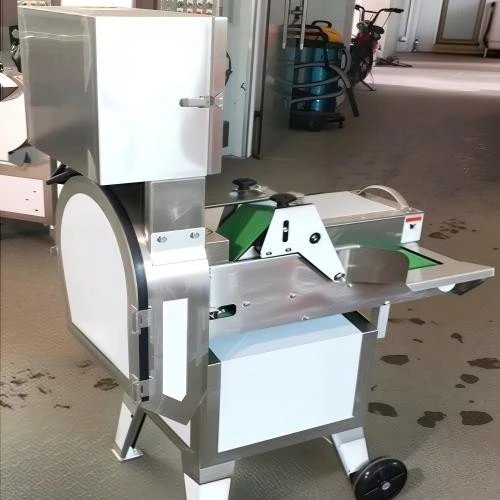
The Green Onion Shredder is a conveyor-fed cutter for scallions, leeks, celery, parsley, coriander, spinach, cabbage, beans, and comparable leafy vegetables. Product is placed on the lower belt and stabilized by an upper pressure belt before reaching the rotary ox-horn knife. Independent speed control for the conveyor and knife lets the operator change the relationship between feed travel and cutting frequency, producing rings, slices, segments, flakes, strips, or julienne-style cuts when the corresponding blade arrangement is available.
This machine is intended for commercial kitchens, fresh-cut preparation rooms, vegetable processors, and central production facilities that need a continuous alternative to hand cutting. At AGICO, we treat the stated 0–60 mm range as a configuration and trial range, not a promise that every material can be cut cleanly at every setting. Stem diameter, leaf condition, bundle thickness, moisture, feed orientation, desired shape, acceptable fines, and downstream handling all influence the practical result. Sending representative vegetables and an approved finished-product sample is the clearest basis for selection.
Features That Matter in Daily Production
Independent Speed Control
Separate inverter controls for the knife and conveyor support practical cut-length adjustment. Operators can record proven settings for each product and target result.
125 or 165 mm Feed Belt
CT-125 and CT-165 references provide different belt widths and output ranges. The correct width depends on bundle size, loading method, production flow, and available space.
Controlled Belt Feeding
The lower conveyor carries vegetables forward while the upper pressure belt helps stabilize them. Even distribution is important because deep or crossed bundles can disturb cut consistency.
Rotary Ox-Horn Knife
The standard rotating knife provides repeated cutting action for leafy and stem vegetables. Blade configuration, sharpness, clearance, and speed must match the requested shape.
SUS304 Construction
The stated SUS304 body supports food-processing use and routine cleaning. Final food-contact materials, guards, surface finish, and cleaning method should be confirmed in the order.
Mobile Floor Installation
Wheels help position the machine for production and sanitation. The unit must operate on a level floor with adequate service clearance and secure positioning.
Technical Data
The following values reproduce the supplied reference information. Model-specific dimensions, voltage, capacity, blade set, and final cut quality require confirmation in the quotation and technical agreement.
| Parameter | Specification |
|---|---|
| Available Models | CT-125 / CT-165 |
| Machine Type | Conveyor-fed leafy vegetable cutter |
| Processing Capacity | 500–600 kg/h or 800–1,000 kg/h |
| Motor Power | 1.5 HP or 3 HP |
| Voltage | 220 V / 380 V |
| Published Dimensions | 900 × 560 × 1,200 mm or 980 × 760 × 1,570 mm |
| Dimension in Supplied Graphic | 750 × 500 × 1,260 mm; exact model must be confirmed |
| Conveyor-Belt Width | 125 mm or 165 mm |
| Adjustable Cutting Length | 0–60 mm |
| Speed Control | Independent inverter control for knife and conveyor |
| Cutting Mechanism | Rotary ox-horn knife |
| Construction / Mobility | SUS304 stainless steel; wheels fitted |
| Feeding Method | Continuous lower belt with upper pressure belt |
Capacity is a reference range rather than a guaranteed result for every vegetable and cut length. Thin rings demand more knife cycles than long segments, while wet or tangled leaves may limit stable feeding. AGICO normally asks for product dimensions, prepared condition, target length and tolerance, hourly and daily volume, acceptable fines, electrical standard, and the next process before recommending CT-125 or CT-165.
The two published machine envelopes should be mapped to the quoted model before layout approval. The separate 750 × 500 × 1,260 mm graphic is useful for visual reference, but its exact configuration remains to be verified. Installation planning should allow more than the nominal machine footprint: reserve space for loading, discharge containers, opening the knife housing, belt inspection, sanitation, electrical isolation, wheel movement, and safe operator circulation.
Finished-product acceptance should also be measurable. Specify a target length, allowable variation, maximum torn leaves or fines, and whether mixed stem and leaf sections are acceptable. Green onion rings for garnish may need a different setting from leek segments intended for cooking. A short controlled trial should record actual feed rate and sample quality instead of relying only on the published hourly range.
Controls, Dimensions, and Main Components
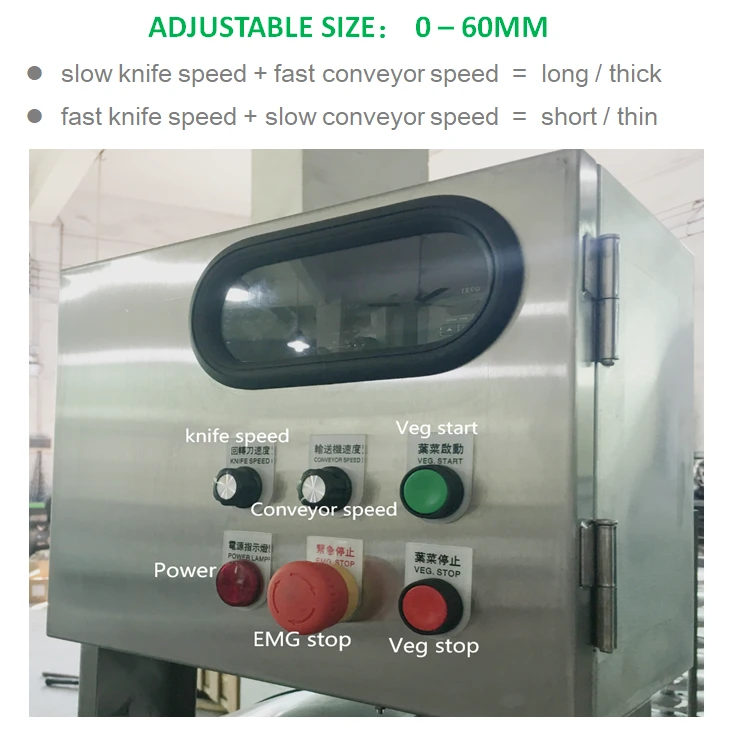
Knife and conveyor controls let operators establish a repeatable combination for the required length. Changes should be checked with samples rather than judged from dial position alone.
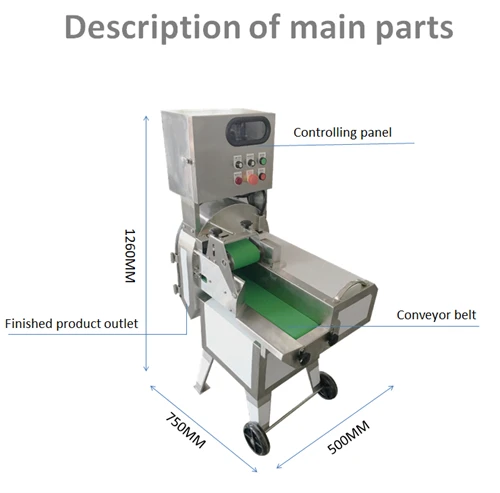
The supplied drawing shows 750 × 500 × 1,260 mm. It is retained as a separate reference and must not be assumed to represent both CT models.
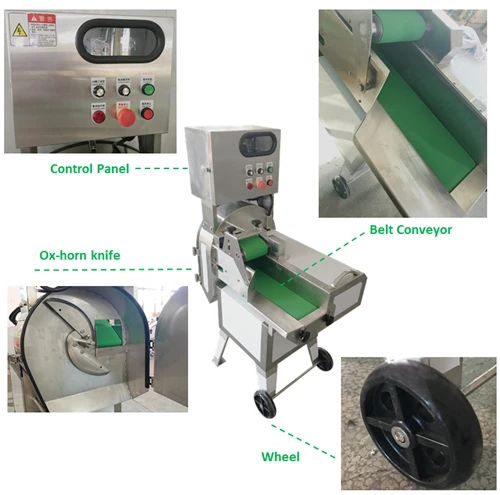
The component diagram identifies the panel, conveyor, rotary knife, and wheels. Guards must remain in place during operation, and access requires safe isolation.
Operating Workflow and Routine Care
01
Prepare the vegetables
Remove roots, damaged material, soil, and foreign objects. Align green onions or leeks consistently and avoid bundles that exceed the confirmed feed height.
02
Set and test the speeds
Begin with the documented knife and conveyor settings, then cut a small sample. Measure length, inspect torn leaves and fines, and adjust one variable at a time.
03
Feed continuously
Spread material evenly on the lower belt and let the pressure belt stabilize it. Do not push hands into the feed or cutting zones, and keep the discharge clear.
04
Isolate, clean, and inspect
Stop and isolate the machine under the plant procedure. Remove retained product, clean suitable food-contact areas, inspect belts and blade condition, verify guards, and check wheel security before restart.
For recurring products, record the vegetable, preparation, knife setting, conveyor setting, target length, measured sample, and corrective action. This gives operators a practical recipe and helps distinguish raw-material variation from equipment adjustment.
Green Onion Shredder FAQ
-
How should CT-125 and CT-165 be compared?
Compare belt width, reference capacity, motor power, machine envelope, typical bundle size, target cut, and available floor space. Confirm the exact model data instead of combining the two specifications.
-
How is cutting length adjusted?
The relationship between conveyor speed and knife speed changes the nominal length. Product behavior and blade configuration still affect the result, so operators should verify every new setting with measured samples.
-
Can one machine make every listed shape?
Not necessarily with one standard setup. Rings, slices, segments, flakes, strips, and julienne cuts depend on the vegetable and installed blade configuration. Send an acceptable sample for confirmation.
-
What should be sent to AGICO for a quotation?
Provide material type, stem or bundle dimensions, prepared condition, target shape and length, tolerance, hourly and daily volume, voltage and phase, upstream preparation, downstream collection, factory space, and cleaning expectations.
Hot Tags: green onion shredder, China green onion shredder manufacturers, suppliers, factory