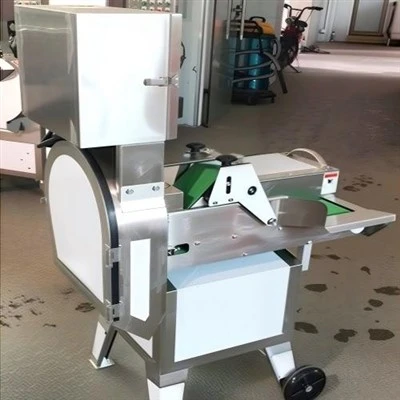
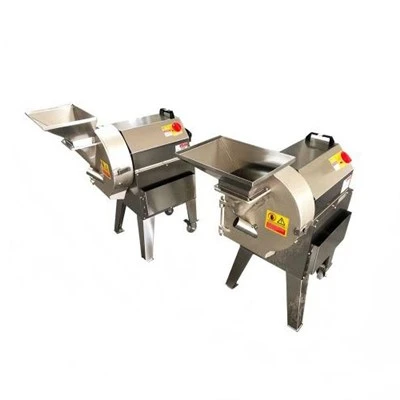
Commercial Lettuce Shredder Machine
The AGICO Lettuce Shredder Machine is a conveyor-fed cutting system for producing strips, slices, and shredded leafy vegetables in continuous commercial preparation. Product travels on a food-grade lower belt while an upper press belt steadies the leaves before they enter the high-speed rotary cutting zone. Independent adjustment of conveyor and knife speed allows the operator to match the cut length to the prepared product and downstream recipe.
Lettuce is light, compressible, and sensitive to bruising. Loose leaves, compact heads, and wet prepared pieces do not feed in the same way. Stable results therefore depend on trimming, moisture control, even belt loading, suitable compression, and a tested relationship between feed speed and knife speed. Published capacity is a reference range across configurations rather than a fixed result for every lettuce variety or cut.

Features That Matter in Leafy-Vegetable Cutting
Continuous Belt Feeding
The lower conveyor presents lettuce to the cutting zone at a controlled rate. Even distribution reduces bunching and helps the knife receive a more consistent layer. The practical loading depth should be established with the actual leaf shape and moisture level.
Upper Press-Belt Control
The upper belt supports loose leaves as they approach the blade. Suitable pressure improves feeding, while excessive compression can bruise delicate lettuce or create an unnecessarily dense layer. Belt position and product thickness must be coordinated.
Adjustable Cut Length
The reference 1–60 mm range covers several cutting tasks. Feed speed and knife speed work together to create the result, so operators should record a proven setting for each product rather than rely on the scale alone.
Stainless Food-Processing Structure
SUS304 construction and food-grade conveyor material support routine sanitation. Cleaning access, belt edges, the guarded cutting zone, and drainage still need to be checked against the plant's procedure and available wash area.
AGICO Technical Data
| Parameter | Reference Specification |
|---|---|
| Reference Model Class | AGICO-180 / AGICO-304H |
| Processing Capacity | Approximately 800–1,500 kg/h |
| Cutting Size | 1–60 mm adjustable |
| Conveyor Belt Width | Approximately 180–200 mm |
| Upper Press Belt Width | Approximately 180–198 mm |
| Motor Power | Approximately 1.9–2.25 kW |
| Reference Voltage | 220 V or 380 V, 50/60 Hz |
| Reference Dimensions | Approximately 980 × 810 × 1,480 mm |
| Alternative Reference Dimensions | 1,220 × 680 × 1,485 mm |
| Reference Weight | Approximately 150 kg |
| Construction Material | SUS304 stainless steel |
| Conveyor Material | Food-grade belt |
| Feeding Method | Continuous conveyor feeding |
| Cutting System | High-speed rotary cutting disc |
| Speed Control | Adjustable conveyor and knife speed |
| Suitable Products | Lettuce, cabbage, spinach, celery, leeks, scallions, coriander and similar leafy vegetables |
These figures describe reference model classes. Final belt width, power, voltage, dimensions, speed range, and practical capacity should be confirmed against the required cut and representative raw material before quotation.

Prepared Input
Define leaf size, head trimming, moisture, and loading depth before selecting a cut setting.

Required Output
Specify target strip width, acceptable fines, breakage limit, and the next preparation or packing step.
Match the Cutting Zone to the Production Task

Set Speed with a Sample, Not an Assumption
The control panel coordinates conveyor delivery and rotary cutting. A thin salad shred, a wider sandwich strip, and chopped leaves for further processing place different demands on the machine. Begin with a conservative feed layer, observe the cut, then adjust one variable at a time. This makes it easier to identify whether an unsatisfactory result comes from belt speed, knife speed, product presentation, or blade condition.
At AGICO, we normally ask for photographs or samples of the prepared input and target output. We also need the hourly requirement and shift pattern. This information prevents selection from being based only on the largest published capacity, which may not represent delicate or irregular lettuce.
Upstream Preparation
Place inspection, trimming, washing, and dewatering before the shredder. Excess surface water can change belt behavior and increase leaf adhesion. Large compact heads may need pre-cutting so the upper belt can hold the product evenly.
Downstream Collection
Use a tote, conveyor, or packing station that accepts the discharge without a high drop. Gentle transfer helps protect thin lettuce strips. The receiving stage must keep pace so cut product does not accumulate near the outlet.
Operating, Cleaning, and Changeover Sequence
Remove damaged material and foreign objects. Trim or pre-cut as required, drain surface water, and distribute lettuce evenly across the feed belt.
Start with a controlled feed layer. Adjust conveyor and knife speed, then inspect a representative output sample before increasing production.
Watch for bunching, belt tracking, cut consistency, and outlet accumulation. Remove product promptly and keep hands away from guarded moving parts.
Stop and isolate the machine before accessing the cutting area. Remove leaf fragments, clean both belts and food-contact surfaces, inspect the blade and guards, and verify drainage before restart.
Leaf fragments can lodge along belt edges and around the cutting zone. Cleaning should follow each run or product change, especially when moving between lettuce, leeks, scallions, coriander, or stronger-flavored materials. Record the accepted speed settings and first approved sample after reassembly. For mixed production schedules, a simple changeover record helps operators restore the proven belt speed, knife speed, loading depth, and receiving arrangement without relying on memory. Our team recommends including sanitation access, belt inspection, and blade checks in the operating routine rather than treating them as occasional maintenance.
Frequently Asked Questions
Can one setting work for all leafy vegetables?
No. Leaf structure, bundle density, moisture, target cut, and blade condition change the required relationship between conveyor and knife speed. Store proven settings by product.
What determines practical capacity?
Capacity depends on preparation, feed-layer thickness, cut length, belt speed, knife speed, operator loading, product condition, and downstream collection. The reference range is not a guarantee for every cut.
How should the conveyor belts be cleaned?
Follow the plant's isolation procedure, remove trapped leaves, wash approved food-contact surfaces, inspect belt edges and tracking, and allow appropriate drainage before reassembly and restart.
What should we send AGICO for model selection?
Provide the vegetable, prepared size, target cut, hourly and shift output, voltage, upstream washer or cutter, downstream collection method, and representative input and output images or samples.
Hot Tags: lettuce shredder machine, China lettuce shredder machine manufacturers, suppliers, factory